Bat Compression testing is one of the most misunderstood parts of composite bat performance. Many people think compression testers are designed to detect shaved bats, rolled bats, or altered equipment directly, but that is not what the machine actually measures.
Bat Compression testers measure barrel stiffness.
That’s it.
They do not determine whether a bat was rolled, shaved, heavily used, naturally broken in, or structurally damaged. The machine simply measures how much resistance the barrel provides when force is applied during testing.
Understanding how compression testing actually works is important because barrel stiffness changes naturally over time as composite bats break down from, break-in, and normal hitting.

Why Compression Testing Gets Misunderstood
People incorrectly assume:
- lower compression automatically means shaved
- passing compression means untouched
- one test reading tells the full story
- rolling and shaving affect barrels identically
None of those assumptions are accurate.
Composite barrels naturally become less stiff as they break in. A heavily used bat, a naturally flexible barrel design, internal structural wear (some rings or disc can break down over time), or aggressive barrel modification can all influence compression readings differently.
This is one reason compression testing creates so much confusion in baseball and softball discussions. Players and tournament directors often treat compression numbers like a direct modification detector even though the machine is only measuring barrel stiffness at a specific moment in time.
Understanding how composite barrels breaks up during break-in helps explain why barrel compression changes naturally over time.
What Compression Testing Actually Measures
Compression testing measures one thing only:
- barrel stiffness
The machine applies pressure to the barrel and records how much resistance the barrel provides before flexing.
Compression testers do NOT:
- detect bat shaving
- detect bat rolling
- identify internal modifications
- determine whether a bat is “good” or “bad”
They simply measure stiffness.
As composite bats break-in from use, the barrels generally become more flexible and compression readings often decrease as a result.
That change can happen through:
- normal gameplay use
- batting practice
- natural break-in
- rolling
- soft toss
- shaving
- internal damage
The tester itself does not know why the barrel became more flexible.
Operator Influence and Testing Variability
One of the biggest misconceptions surrounding compression testing is the assumption that readings are perfectly precise.
They are not.
Compression readings can vary depending on:
- machine calibration
- operator technique
- barrel positioning
- mechanical gauge lag
- testing pressure consistency
Even slight additional pressure applied to the testing frame can influence readings noticeably.
Most compression testers are built with tolerance ranges, yet players often treat single readings as absolute measurements without considering mechanical variability or testing inconsistency.
This is one reason experienced testers often pay attention to multiple readings, barrel condition, and overall bat behavior instead of treating one isolated number as definitive proof of anything.

Does Compression Testing Detect Rolled or Shaved Bats?
No.
Compression testing does not directly detect rolled bats or shaved bats.
A compression tester cannot determine how a barrel reached its current stiffness level. It only measures whether the barrel remains above or below a specific compression threshold.
A lower compression reading does not automatically explain how the barrel reached that condition.
Some composite bats lose stiffness gradually through normal gameplay and break-in, while others may show compression changes because of internal wear, accelerated break-in, or barrel modification.
The tester itself cannot determine why the barrel became more flexible — it only measures the current stiffness of the barrel during that specific test.
The Role of Bat Rolling in Compression Changes
Bat rolling is a controlled break-in process that attempts to accelerate the natural loosening of composite fibers through applied pressure across the barrel.
No material is removed during rolling.
As composite bats break-in, barrel flexibility naturally changes, which is why rolled bats may show lower compression readings and, over time just like heavily used bats do.
Some composite bats respond aggressively to bat rolling while others remain relatively stiff for long periods depending on:
- trampoline effect
- composite patterns
- reinforcement placement throughout the shell
- structural response under load
This is why not every bat reacts identically to rolling or gameplay use.
Players researching composite break-in often misunderstand how much barrel stiffness changes naturally once a composite barrel begins flexing more efficiently through repeated impact.
The Role of Bat Shaving in Compression Changes
Bat shaving affects compression differently because material is physically removed from inside the barrel wall itself.
Reducing internal barrel thickness generally increases barrel flex and reduces structural stiffness, which often lowers compression readings more dramatically than standard break-in alone.
However, bat shaving still does not guarantee a failed compression test.
A shaved bat may still remain above a testing threshold depending on:
- shave depth
- barrel design
- overall condition
- prior use
- original stiffness
This is why compression testing alone cannot reliably determine whether a bat has been shaved.
Players researching structural barrel modification often focus only on performance changes while underestimating how much shaving increases durability risk and long-term barrel stress.

Why Bats Fail Compression Testing
Bats typically fail compression testing because the barrel has become too flexible.
That flexibility may result from:
- heavy gameplay use
- natural break-in
- structural fatigue
- excessive barrel wear
- aggressive modification
- internal separation
- cracking or hidden damage
In many cases, abnormal compression readings are caused by internal structural problems rather than break-in methods alone.
This is why some composite bats showing unusual compression behavior may require structural inspection or composite bat repair depending on the type of barrel damage involved.
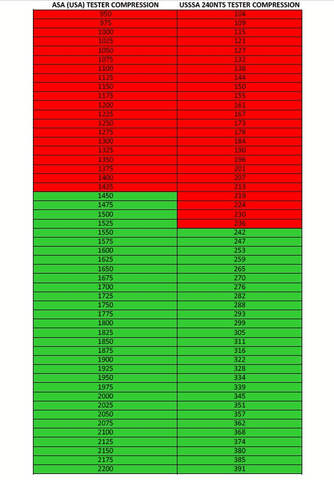
Common Compression Thresholds
Compression thresholds vary depending on league, sanctioning body, and bat type.
USA / ASA Slowpitch
1450 PSI and above
USA / NCAA Fastpitch
1550 PSI and above
USSSA Slowpitch
240 and above
BBCOR Baseball
1250 lbs Metal (alloy) bats
1000 lbs Composite bats
The Reality of Compression Testing
Compression testing is a filtering tool, not a truth detector.
Its purpose is to identify barrels that have become excessively flexible, structurally compromised, or outside association threshold ranges. It does not explain why the barrel changed or how the bat reached its current compression reading.
Understanding barrel stiffness, break-in behavior, structural wear, and composite responsiveness gives far more useful information than compression numbers alone.
Big Dawg Bats has specialized in composite bat performance, compression-awareness, bat rolling, bat shaving, and composite bat repair since 2006.
Understanding what a compression tester actually measures is important when evaluating bat performance, barrel stiffness, and break-in progression. Players looking for a professionally developed composite barrel can learn more about our Controlled Composite Break-In Service →
Conversion Compression Numbers: USA/ASA to USSSA